The Patron: François I
Chambord was commissioned by King François I of France in 1519. He was 25 years old, recently returned from his Italian military campaigns, and determined to build something that would outshine everything he had seen in Milan, Venice, and Rome. The Italian Renaissance was transforming European architecture, and François — educated, ambitious, and deeply susceptible to the power of art and architecture as political statement — intended France to catch up.
He chose the site of a former hunting lodge in the Sologne forest, on the edge of the Cosson river. He redirected the river to create a moat. He ordered a building of unprecedented scale: a central keep on a Greek cross plan, surrounded by a larger rectangular block, all enclosed by towers and a defensive ditch. The budget was open-ended. The timeline was irrelevant. He visited the construction site an estimated 72 times during his reign, stayed for a total of perhaps 72 days, and died in 1547 without seeing it finished.
The Builder: Domenico da Cortona
The architect most reliably associated with Chambord's design is Domenico da Cortona, an Italian-born architect who had been in France since the reign of Charles VIII. He is documented as having produced a large wooden model of the château before construction began — the primary evidence for his role in the design.
Domenico was part of a group of Italian craftsmen and architects that François I brought to France specifically to introduce Renaissance architectural ideas. His name appears in royal records. His model is referenced in contemporary documents. He is the closest thing to a documented architect that Chambord has.
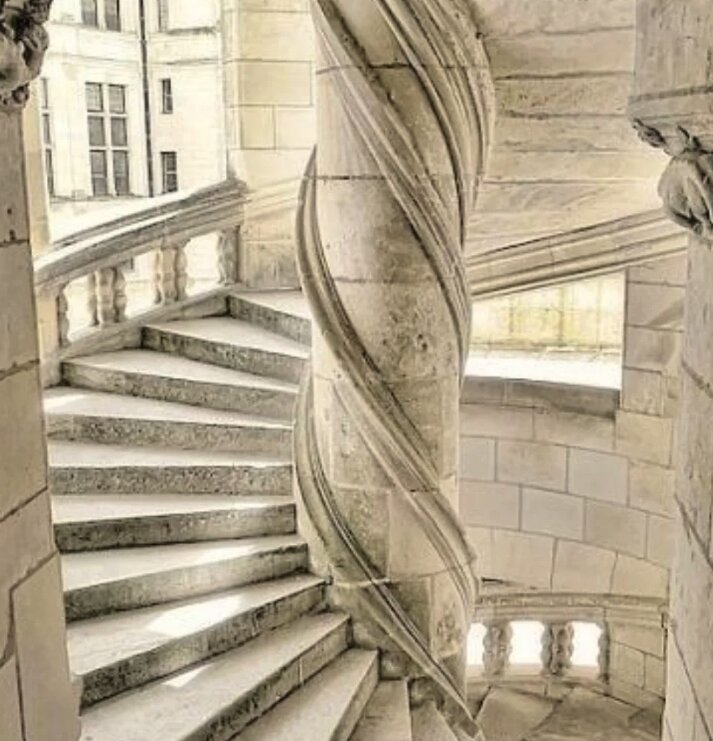
But the double-helix staircase — the château's most extraordinary and unprecedented feature — is not something that Domenico da Cortona is known to have developed independently in any other building. Which brings us to the other name.
The Question: Was Leonardo da Vinci Involved?
Leonardo da Vinci arrived in France in 1516, invited by François I after the king encountered his work in Milan following the French conquest of the city. He was 64 years old — old, by the standards of the time, and no longer painting. François installed him in the manor of Clos Lucé in Amboise, 18 kilometres from the site where Chambord would be built. He gave him an annual pension of 700 écus, a generous household allowance, and — according to contemporary accounts — his personal friendship.
Leonardo died at Clos Lucé on 2 May 1519. Construction of Chambord began in September 1519. The overlap in time and space between the two events has fascinated historians for two centuries.
What we know from Leonardo's notebooks — the Codex Atlanticus, the Madrid Codices, and related manuscripts — is that he had been sketching double-helix structures and interlocking staircase configurations for years before his death. These appear in drawings of ideal cities, in mechanical studies, and in architectural sketches that were never realised as buildings. The conceptual framework for a double-helix staircase — two spirals around a hollow column, interlocking but never meeting — is present in Leonardo's notebooks before Chambord was built.
There is no document that names Leonardo as designer of the staircase. There is no contract, no payment, no letter in which François I or any court official attributes the design to him. What there is, is a proximity and a timing that is difficult to regard as entirely coincidental.
Most architectural historians today hold a position of "probable influence, unproven authorship." Leonardo almost certainly discussed architectural ideas with François I and with the Italian designers around him. His conceptual fingerprints are on the staircase. Whether he should be called its architect — in the sense of having produced the working drawings that the builders followed — remains unknown and may be unknowable.
After François I: A Castle Completed by Different Hands
The château that visitors see today is not purely François I's Chambord. It was substantially completed and modified by subsequent monarchs:
- Henri II continued building work through the 1550s and 1560s.
- Louis XIV, in the 1670s–1680s, added the royal chapel, the formal gardens to the south, the final furnishings of the royal apartments, and the stables. The Chambord that is now a museum — with its 17th-century furniture, tapestries, and portraits — is substantially Louis XIV's creation as much as François I's.
If François I is the father of Chambord, Louis XIV is the stepfather who finished the child's upbringing and sent it into the world.
How Long Did It Take to Build?
Construction of the main château block and central keep took approximately 28 years under François I (1519–1547). Work continued under Henri II. Louis XIV undertook major works in the 1660s–1680s. The formal gardens were restored most recently in 2017. In a sense, Chambord has been under construction, renovation, or restoration for most of its five centuries. The stone you touch on the rooftop terrace today may have been carved in 1530, repaired in 1680, or consolidated in 1985.
See the Staircase for Yourself
Every Chambord Castle tour includes access to the double-helix staircase. A guide will give you the full debate — the evidence for Leonardo, the evidence against, and the architectural analysis of why the staircase is so remarkable regardless of who designed it. Tours from Paris from $152 per person, entry included. The full staircase page covers the da Vinci question in even more depth.