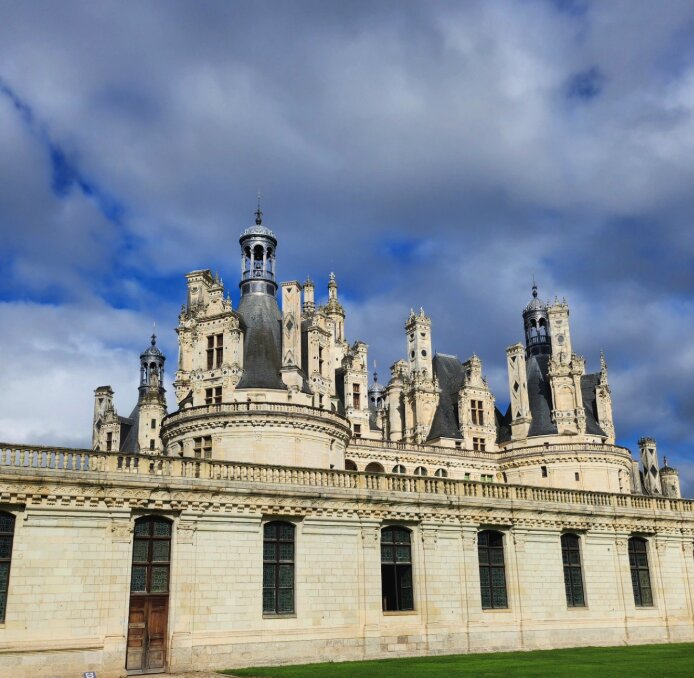
Why Chambord Is One of France's Most Photographed Buildings
Château de Chambord is among the most recognisable buildings in France — and among the most challenging to photograph well. The problem isn't finding a good angle; it's choosing between dozens of extraordinary ones. The north façade at dawn, the south façade from the canal, the rooftop looking down at 365 chimneys, the double-helix staircase from above — each is a different picture, and each rewards the photographer who arrives with a plan.
Exterior: The Best Angles
1. The North Façade at Opening Time (9:00–10:00am)
The north façade is the principal face of the château — the view from the car parks, from the main approach road, and from most published photographs. It is best in the first hour after the château opens, when the morning light comes from the south-east and hits the tuffeau limestone at an angle that makes the stonework glow. By 10:30am, the light is increasingly overhead and flatter. By midday, the north-facing wall is in shade.
The best position is from the gravel esplanade directly in front of the main gateway, or slightly to one side to include the moat in the foreground. A wide lens captures the full façade including the flanking towers. A telephoto compresses the roofscape beautifully — the chimneys stack up against each other.
2. The Canal Approach from the South (Best at Golden Hour)
This is the view that Louis XIV intended — and the one most visitors miss because it requires walking or cycling into the estate rather than standing in the car park. From the south, the central canal runs from the château's south façade through the formal gardens and into the forest. Standing 300–400 metres down the canal at late afternoon, the château reflected in the still water with the formal garden parterre visible between you and the building, is the finest single view the estate offers.
The light here is best in the two hours before sunset — the sun is in the west, the south-facing façade is fully illuminated, and the water reflection is at its most intense. In September–October, the oaks on either side of the canal are turning gold. This is the photograph.
3. From the Forest Rides
The estate's long straight forest roads (allées forestières) were designed, in the 17th-century tradition of formal landscape design, to provide views of the château from the forest. Several converge on the château at angles that are not available from the car-park approach. These rides are accessible by foot or bicycle from the main entrance.
The ride approaching from the north-west offers a view of the château's corner towers above the tree line that is almost impossible to reproduce from the conventional north approach — the building seems to float above the forest. Dawn in September, with mist on the ground, is when this works best.
4. The Moat Walk
Walking the perimeter of the château's outer moat (dry today, but still a defined channel) gives access to angles that include both the château and its immediate surroundings. The east and west sides of the building receive morning and afternoon light respectively — useful for finding a spot that's not in direct sunlight or deep shadow depending on the time of day.
Interior: The Double-Helix Staircase
The staircase is the most dramatic interior subject in the building and one of the most challenging to photograph. The challenge is the light: the central hollow column lets in light from the lantern above, but the spirals themselves are in relative shadow. A smartphone camera in auto mode will usually expose for the bright column and underexpose the stonework around it.
The Key Shot: Looking Up the Column
Stand at the base of the staircase and look directly up through the central hollow column to the lantern at the top. This is a vertigo-inducing upward spiral with light at the end — the most reproduced interior image of Chambord. For the best result: use a wide-angle lens or phone camera, brace against the column for stability, and shoot slightly before or after the building's peak hours (before 10:30am or after 4:00pm) when other visitors aren't in the frame above you.
Looking Down from Above
From the upper landings, looking down through the column gives a different picture — the two spirals visible simultaneously, with visitors below moving in both directions. A fast shutter speed freezes the movement; a slow shutter blurs it deliberately. Both work.
The Rooftop Terrace: Looking Down at the Chimneys
From the rooftop, the 365 chimneys extend in every direction. Each is individually carved and decorated. A wide-angle view captures the sheer density of the skyline; a telephoto selects individual chimney tops against the sky. The most published composition is from the terrace looking south-west, with the lantern tower visible above and the forest visible to the horizon.
The Royal Apartments
Photography is permitted in the royal apartments (no flash). The rooms are lit by window light and some internal lighting — conditions vary significantly through the day. Morning light comes through the north-facing windows; afternoon light through the south-facing rooms on the upper floors. The tapestries and painted portraits photograph well in the diffused window light; flash would bleach them.
Practical Tips
- Best light overall: Golden hour (first hour after sunrise or last hour before sunset) for exterior. Early morning for interior.
- Avoid midday: The north façade is in shade. The interior is at its most crowded. The light on the formal gardens is flat.
- The formal gardens: Best viewed from the rooftop terrace for pattern shots; best photographed from ground level for detail shots of the box hedges and parterres.
- Wildlife: Dawn in September–October for deer in the estate. The moat perimeter and forest rides at dusk for wildlife activity.
- Drone photography: Not permitted without advance permission from the Domaine national de Chambord.
- Tripods: Permitted on the exterior; require advance permission for the interior.
Visit Chambord on a Guided Tour
A Chambord Castle tour guide will show you the best viewpoints and explain what you're photographing — the history behind the façade, the name of the king whose emblem appears on the chimney you're framing. Tours from $152 per person from Paris, with entry tickets included. Or book a private golf cart tour to reach the canal and south façade approach that most visitors never find.